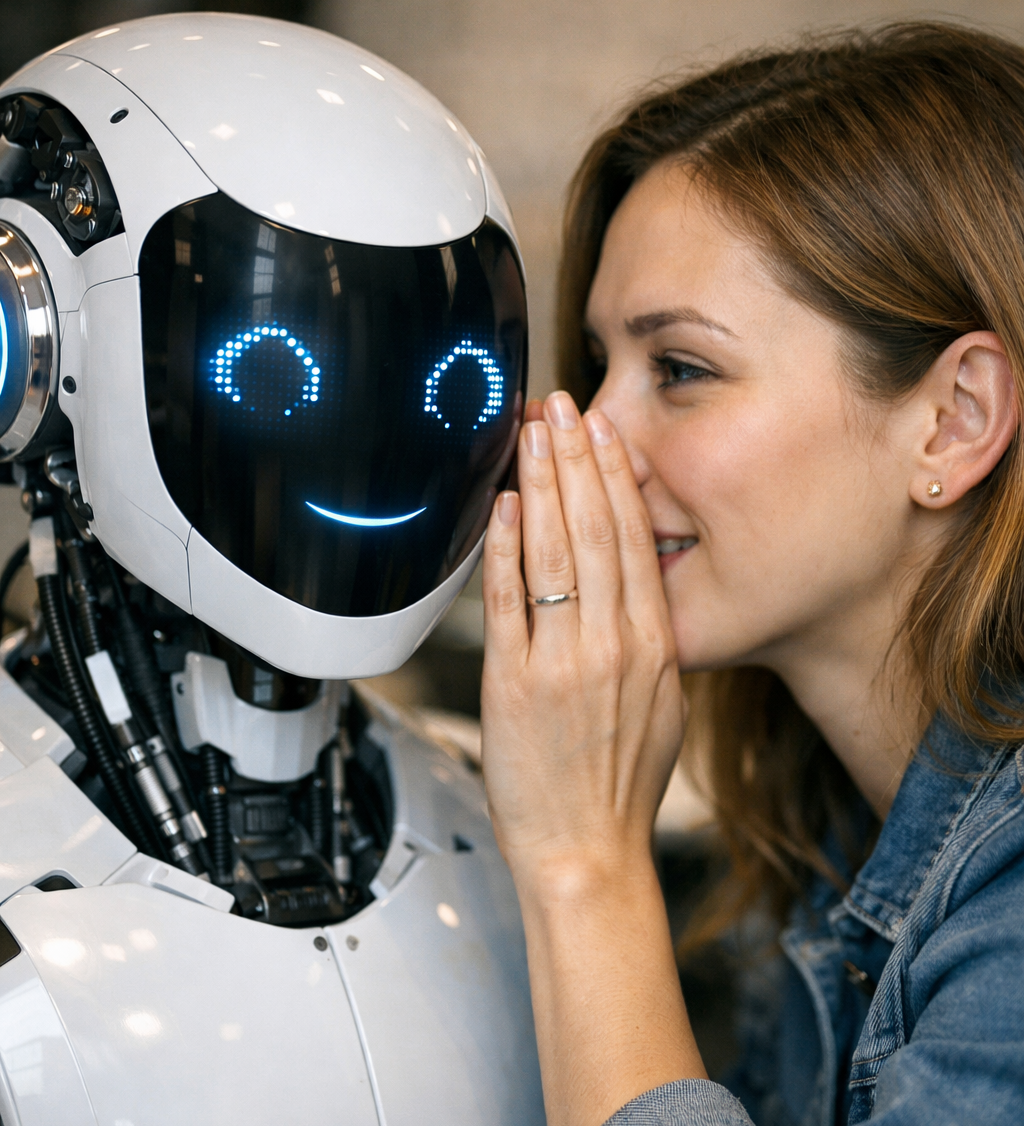
Don't look now, but that toaster is checking you out
I suspect I'm not the first lawyer dealing with clients who use AI to draft emails, then challenge every piece of advice with, 'But ChatGPT said...' I can only imagine the ordeal family doctors face. Their struggles began with WebMD, intensified when 'Facebook Medical' experts emerged, and now, with AI, everyone believes they're an authority on...just about everything.
But, AI can be useful, right? When I bump into a topic I don't know much about, I'll jump on whatever LLM I'm playing with and start asking questions. So, why wouldn't I ask it to draft a patent application?
A recent study published on arXiv, “Extracting books from production language models,” raises serious questions about using AI in sensitive legal workflows, particularly in patent drafting.
The authors investigated whether widely used large language models (LLMs) can be induced to reproduce whole (or almost whole) copyrighted books. Using a two-phase extraction method, they tested four major models and found it was possible in some instances to extract almost an entire book.
This is important not just for (patent) law but for anyone thinking about the secrecy of what they're sharing with an AI. If a model can reveal training data it was never meant to “remember,” that suggests deep memorization of private inputs and raises red flags about how much of what you ask an AI stays confidential.
Patent law hinges on novelty and public disclosure. A disclosure is any information made available to the public that could reveal key features of an invention before a patent application is filed. Traditional examples include publications, talks, public use, or offers for sale. But there are less intuitive disclosures as well—such as posting drafts online, sharing slides in a public forum, or any situation where a skilled reader could reconstruct your invention. Even a thesis sitting in a library collecting dust can be a public disclosure.
When you ask an AI something, anything, you've left it out of your control. Maybe you have paid access to a model and checked the little box to opt out of your input being used for training. Maybe you can trust the AI to pay attention to that checkbox. Maybe you can trust that no logs are kept even if they're not used for training. Maybe you can trust there will never be a breach.
Maybe not.
I don't know, and neither do you.
I do know, however, that I don't want to be a test case.
I see at least two issues with having an AI write a patent application.
Your input might be a “public disclosure.” Even if the AI doesn’t publish your content, some patent attorneys (including yours truly) worry that telling the model about your invention could be considered a public disclosure. Maybe it doesn't. We don't know what courts will eventually determine and again, I don't want to be the test cas.
The model might inadvertently generate outputs based on training data from other sources. If the AI is being trained on patent disclosures, a bit of those disclosures could find their way into your AI-drafted application and who knows what kind of odd problems that would introduce?
The thing is, that might not even be the biggest problem with letting an AI draft your patent application.
I've tried a few different AIs to see what kind of patent application I could get from a fairly detailed plain-language invention disclosure and from the claims. I have a pretty simple, easy-to-understand patent I've been using for testing.
Results haven't been great. The AI just can't grasp the invention, but does do a pretty good job with rewriting text. The claims it's generated aren't good, but if I give the AI some claims I've drafted, it does a pretty good job of cleaning things up, getting commas and semicolons right, ensuring terminology is consistent across claims, and catching antecedent basis problems. Where I've seen the greatest benefit is in brainstorming terminology. Things like "how can I describe how a vice grip works, particularly how that final push works to lock the jaws?" or "what's a more patent-like way of saying the tire is pumped up just barely enough?"
The worst part is more insidious: the output looks really good. The grammatical structure is solid (even the weird structure of patent claims) and the terminology is good. It's when you have some idea of what you're doing that the output starts to fall apart. Irrelevant information may be injected that unnecessarily narrows a claim; functional language might be added where it doesn't belong; or any one of a number of issues that simply wouldn't be caught by most people using AI to draft their application.
There is certainly a place for AI in patent drafting, I'm just not sure where it is.
On the other hand, sometimes AI just effin nails it.